Urban Planning and Renovation on the French and Monaco Riviera
Planning and Renovation Constraints in Roquebrune-Cap-Martin
This guide explains how planning and renovation constraints should be understood in Roquebrune-Cap-Martin. It is designed for international buyers who may be attracted by Monaco adjacency, view-led stock, and the idea of creating extra value through future change. The goal is not to describe the commune generically. It is to show how topography, mixed building conditions, Monaco-adjacent expectations, view sensitivity, and local project constraints can materially affect whether a renovation, extension, or redevelopment thesis is really strong enough to influence the purchase decision.
- Why Roquebrune-Cap-Martin should not be read as one uniform project environment
- How topography, Monaco adjacency, and view sensitivity shape renovation logic
Key takeaways
What this Roquebrune-Cap-Martin planning guide helps clarify
- Why Roquebrune-Cap-Martin should not be read as one uniform project environment
- How topography, Monaco adjacency, and view sensitivity shape renovation logic
- Why building conditions and site access can materially affect project ambition
- How buyers can misprice future change when they focus too heavily on location positioning
- Why project discipline matters especially in mixed and micro-location-driven parts of the commune
Why Roquebrune-Cap-Martin creates a mixed planning and renovation environment
Roquebrune-Cap-Martin does not present one simple renovation logic. The commune contains different residential conditions, different relationships to Monaco, and different levels of site and building complexity. That means buyers cannot safely read planning and renovation potential through one broad label. A Monaco-adjacent project, a view-driven hillside property, and a calmer coastal asset under the same commune name may carry materially different project realities.
This is one reason Roquebrune-Cap-Martin can be attractive but easy to misread. Buyers often focus on strategic position and prestige adjacency first, while underestimating how much the exact site and the exact built environment change the real feasibility of the works they are mentally pricing in.
Why Monaco adjacency can distort project assumptions
Buyers drawn to Roquebrune-Cap-Martin often bring a Monaco-led logic into the file. That may be commercially understandable, but it can also create false confidence. Proximity to Monaco does not simplify French planning, building, or renovation reality. A project that feels strategically justified because of location may still sit inside a much more ordinary or demanding French project environment than the buyer's mental pricing suggests.
That is why buyers should be careful not to let border positioning do the thinking for them. The practical answer still depends on the site, the nature of the property, the intended works, and how exposed the project becomes once views, slopes, access, and visible change enter the picture.
- Monaco proximity can increase desire without increasing project freedom
- French planning and renovation logic still governs the project
- Strategic location should not replace site-by-site discipline
- Micro-location inside the commune can change the project materially
Why topography and view sensitivity matter so much here
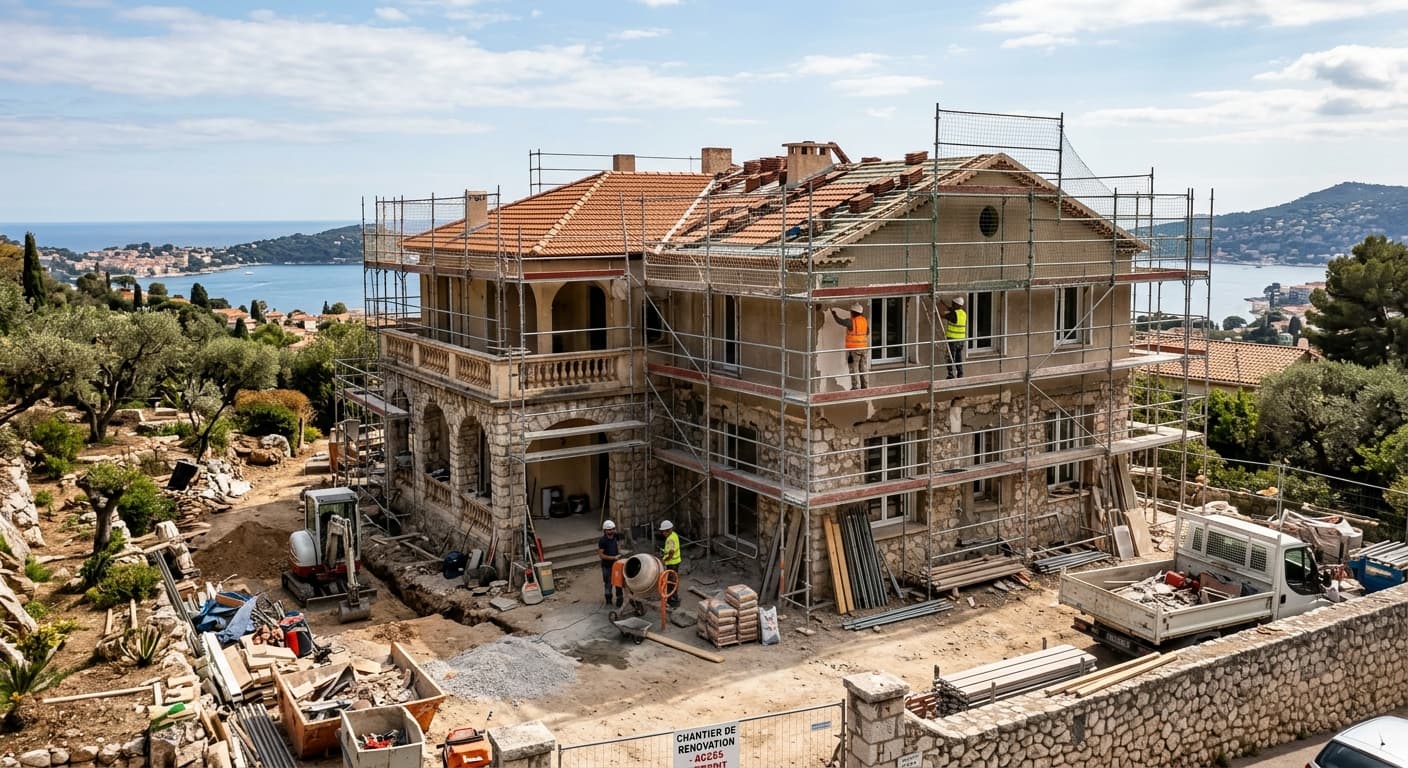
Roquebrune-Cap-Martin often involves slopes, strong outlook value, exposed settings, and properties whose appeal depends heavily on what the buyer sees from the site. That can make renovation or extension ideas feel compelling very quickly. But those same qualities can also increase the sensitivity of visible change, external works, access logic, and the technical burden of a project.
In practical terms, that means the more a buyer is paying for view-driven upside, the more carefully future interventions should be tested before they become part of the acquisition story. A project that looks elegant in concept can become much weaker once the hillside, access, and visual exposure are taken seriously.
Why building condition and stock quality can quietly reshape the project
The commune's mixed stock is another reason buyers need precision. Some assets may seem renovation-friendly because their current condition is weak relative to their setting. But weaker building condition does not automatically create strong renovation logic. It may instead reveal heavier technical burden, structural limitations, or a project drifting toward something closer to reconstruction than the buyer first assumed.
That is why buyers should not equate dated stock with easy upside. In Roquebrune-Cap-Martin, the stronger the site, the easier it can be to overpay for future transformation that still depends on a harder project path than the initial viewing suggests.
How project-driven buyers should read Roquebrune-Cap-Martin before purchase
The safest approach is to treat the commune as a place where future-project logic must stay highly local. A property may be attractive because of strategic position, but the deal should still be judged against the narrower scenario: what if the renovation is slower, the extension is harder, the view-sensitive works are more constrained, or the building itself is weaker than hoped?
If the acquisition still makes sense under that tighter reading, the opportunity may be robust. If it only works under a generous transformation thesis supported mainly by location enthusiasm, the file is probably more fragile than it looks.
What international buyers often underestimate
International buyers often underestimate how much Roquebrune-Cap-Martin's variety affects project logic. They may feel they understand the commune because they understand its position near Monaco. In reality, the property still needs to be read through access, slope, visibility, building condition, and the specific nature of the intended works.
The safer mindset is to treat Roquebrune-Cap-Martin as strategically attractive but operationally uneven. That usually leads to better pricing discipline and better judgment about whether the future project is strong enough to support the purchase.
Related reading
Related reading and next steps
These pages help connect Roquebrune-Cap-Martin's local project logic to view sensitivity, rebuilding assumptions, and the wider area context.
Guide
Urban Planning and Renovation on the French and Monaco Riviera
A practical editorial guide to planning constraints, renovation feasibility, extension logic, and pre-purchase risk for international buyers on the Riviera.
Related Page
Why Seafront and View Properties Come with Hidden Constraints
A practical editorial guide to why seafront and view-driven Riviera properties often carry hidden planning, renovation, and technical constraints before purchase.
Related Page
Can You Demolish and Rebuild a Riviera Property?
A practical editorial guide to how buyers should think about demolition and rebuilding potential before buying on the Riviera, especially when redevelopment value is part of the acquisition logic.
Related Page
How to Read Planning Risk Before Purchase
A practical editorial guide to how buyers should identify planning risk before purchase, especially when future project freedom is part of the reason the property looks attractive.
Area Guide
Roquebrune-Cap-Martin
A strategic Roquebrune-Cap-Martin area guide for international buyers evaluating residential property, buyer fit, micro-location logic, and Monaco-to-Menton positioning.
Area Guide
Cap-d'Ail
A strategic Cap-d'Ail area guide for international buyers evaluating residential property, Monaco proximity, buyer fit, and practical French Riviera realities.
Area Guide
Monaco
A strategic Monaco area guide for international buyers evaluating residential property, buyer fit, practical realities, and local market logic.
Next
Use this page to test Roquebrune-Cap-Martin through project realism, not only through positioning
Roquebrune-Cap-Martin can be strategically compelling, but the renovation and planning logic still depends heavily on the exact site, the exact stock, and the exact project being imagined. The more the purchase depends on future change, the more local and disciplined that reading needs to be.
Use this next
Move into the section that answers the most immediate procedural or structuring question first.