Urban Planning and Renovation on the French and Monaco Riviera
How to Check Whether a Property Can Be Extended
This guide explains how buyers should think about extension potential before purchase. It is designed for Riviera acquisitions where the project only becomes truly attractive if additional volume can be added. The aim is not to answer with a simplistic yes or no. It is to show why visible space, an open garden, or a weakly used roofline are not the same as real extension feasibility, and why a serious extension thesis needs more than visual optimism before a buyer commits.
- Why apparent physical space does not automatically mean buildable extension potential
- How local planning rules and site context shape the real answer
Key takeaways
What this extension guide helps clarify
- Why apparent physical space does not automatically mean buildable extension potential
- How local planning rules and site context shape the real answer
- Why co-ownership, structure, access, and topography can narrow the project
- How protected or coastal environments change extension assumptions
- Why extension feasibility should affect price and purchase discipline
Why buyers overread apparent space
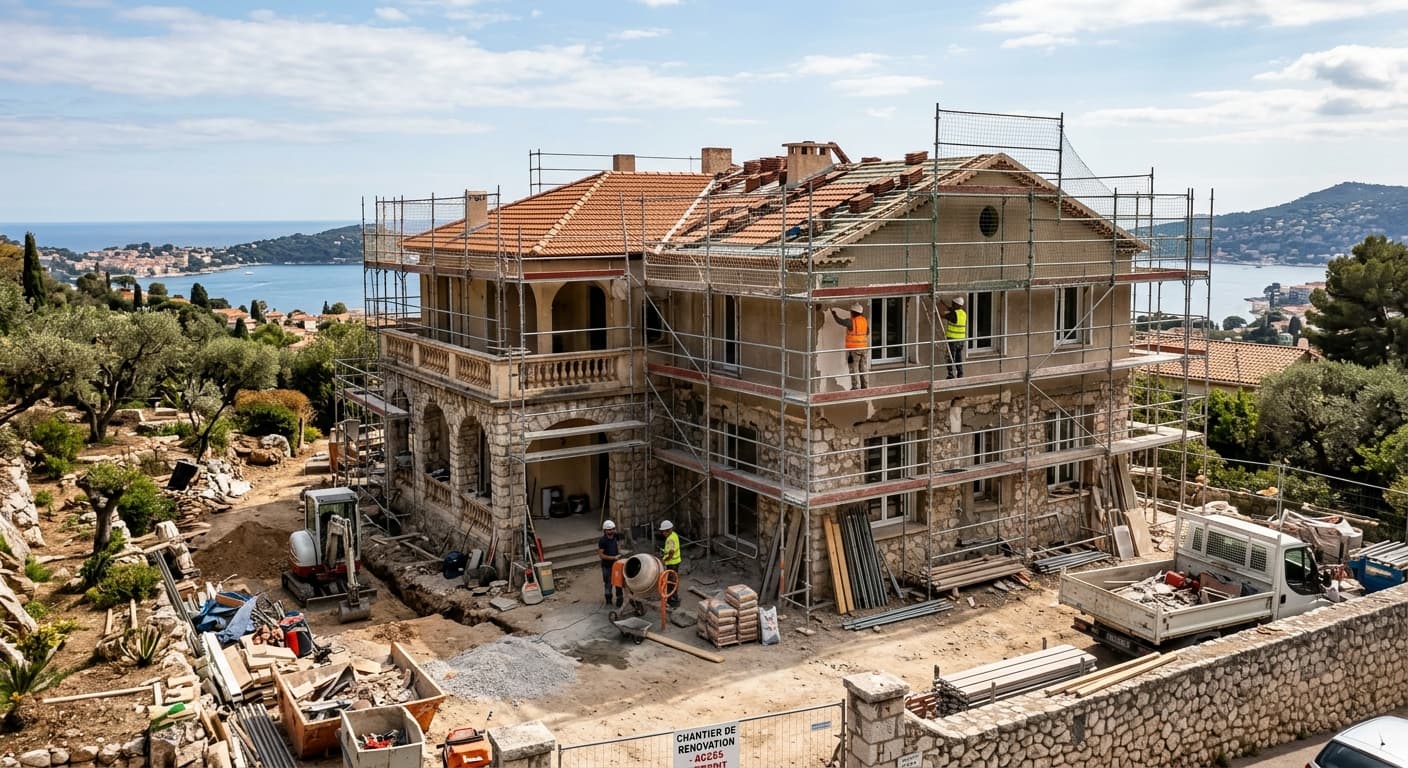
One of the most common Riviera acquisition mistakes is to equate available-looking space with extension freedom. A large plot, a flat garden corner, a roof area, or a side setback can create a powerful sense that adding volume should be straightforward. But apparent emptiness is not the same thing as legally and practically usable development capacity.
This matters because buyers often form their pricing logic very early. They start thinking in terms of what the house will become once enlarged, not only what it is today. If that enlargement is later reduced or blocked, the whole purchase logic can start to unravel.
What needs to be tested before extension potential becomes credible
A credible extension thesis needs more than an architect saying the site looks promising at first glance. It requires enough pre-purchase clarity to understand whether the local planning framework, the existing building, and the site itself support the type of extension the buyer is imagining. The precise answer depends on what kind of project is being considered: a modest addition, a major reconfiguration, vertical growth, or a more visible transformation.
Buyers should be careful not to collapse all extension questions into one category. A site may support one kind of enlargement while making another much more sensitive. What matters is not extension in the abstract, but the specific version of extension on which the purchase value depends.
- The exact form and scale of the intended extension
- The local planning framework attached to the site
- The relationship with the existing building footprint
- Topography, access, and technical site constraints
- External appearance and visibility issues
- Whether the project still works if the extension must be smaller or narrower
Why site conditions often matter as much as zoning logic
Extension analysis is not only a paper exercise. Riviera topography, retaining requirements, access challenges, neighboring relationships, and practical construction constraints can materially affect whether a project remains realistic even when a buyer initially feels reassured by the legal side. Hillside properties in particular can look generous in aerial imagination while proving much more constrained in buildability and execution.
That is why a buyer should not stop at broad statements about what the planning framework may permit. The site itself can change cost, complexity, design options, and the credibility of the overall project. A theoretically possible extension can still be weak as an acquisition premise if the practical path becomes too narrow, too visible, too technically awkward, or too expensive relative to the value created.
Why co-ownership and building form can narrow the project
Some extension assumptions fail not because of the surrounding land, but because of the building environment itself. Apartments, villas inside regulated environments, and properties with shared structures may carry co-ownership or building-level limits that narrow what can be changed. Roof rights, façade modifications, structural interventions, and visible external changes can all become more delicate than the buyer first expects.
This is one reason extension should never be treated as a purely planning question. A buyer may hear that local rules do not obviously prohibit a change and assume the hard part is done. In reality, the project may still be weak because shared-building logic or technical constraints make the intended path impractical or unstable.
Why protected and coastal settings need more skepticism
Riviera buyers are often attracted to exactly the kinds of sites that deserve more caution: exposed views, prestigious slopes, historic settings, or coastal environments. These locations often create emotional conviction that the property is special and therefore worth improving aggressively. They can also create the opposite planning reality, where visibility, setting, and environmental sensitivity narrow what can be achieved.
That does not mean extension is impossible in these contexts. It means the burden of realism is higher. The buyer should be slower to assume that value can simply be manufactured by adding volume, especially where the surrounding character and location quality are part of what make the property sensitive in the first place.
How extension logic should affect the deal
If the asset only makes sense because of the added square meters the buyer expects to create, then extension feasibility belongs inside valuation, negotiation, and risk management before signing. The question is not whether the extension dream is attractive. It is whether the purchase still deserves commitment under a less generous outcome than the one first imagined.
A disciplined buyer should therefore judge the deal against a constrained extension scenario, not against the most optimistic one. If the transaction only works under a highly favorable reading of planning and site conditions, that is not just a design issue. It is a structural warning about how much assumption is being carried into the acquisition.
Related reading
Related reading and next steps
These pages help connect extension potential to wider planning discipline and Riviera pre-purchase renovation review.
Guide
Urban Planning and Renovation on the French and Monaco Riviera
A practical editorial guide to planning constraints, renovation feasibility, extension logic, and pre-purchase risk for international buyers on the Riviera.
Related Page
What Urban Planning Rules Matter Before Buying on the Riviera
A practical editorial guide to the planning and urban-rule questions buyers should test before buying on the Riviera, especially when future works, extension, or alteration matter.
Related Page
How to Read Planning Risk Before Purchase
A practical editorial guide to how buyers should identify planning risk before purchase, especially when future project freedom is part of the reason the property looks attractive.
Area Guide
Eze
A strategic Eze area guide for international buyers evaluating view-driven residential property, privacy, elevation tradeoffs, and practical Riviera realities.
Area Guide
Roquebrune-Cap-Martin
A strategic Roquebrune-Cap-Martin area guide for international buyers evaluating residential property, buyer fit, micro-location logic, and Monaco-to-Menton positioning.
Area Guide
Cap-d'Ail
A strategic Cap-d'Ail area guide for international buyers evaluating residential property, Monaco proximity, buyer fit, and practical French Riviera realities.
Next
Use this page to judge whether 'space' is really opportunity
Extension value should only enter the acquisition logic once it survives local rules, site conditions, and building reality. The safest approach is to test the narrower scenario first, then decide whether the property still deserves the same level of price and commitment.
Use this next
Move into the section that answers the most immediate procedural or structuring question first.